Biography
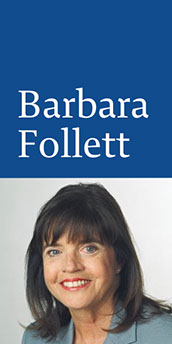
Daphne Barbara Follett was born in Kingston, Jamaica, on Christmas Day 1942. The eldest child of an insurance expert, Barbara – as she was always known - spent her early childhood in Britain and Ethiopia. In 1957 her family moved to South Africa where Barbara finished her schooling. In 1963 she married Richard Turner and left for Paris where he completed his Doctorate in philosophy at the Sorbonne in 1966. Barbara had hoped to continue her studies in Fine Arts at the Ecole de Beaux Arts but, with the arrival of her first child, Jann, in 1964, she had to supplement their finances by teaching English as a second language. In 1966 Barbara returned to South Africa to help Richard manage his mother’s fruit farm in Stellenbosch. There she almost immediately became involved with the anti-malnutrition charity, Kupugani, and by the 1970s she was managing its operations in the Cape and Namibia and directing its health education programmes nationally.
Barbara’s second child, Kim, was born in 1968 but by 1970 her marriage to Richard Turner had come to an end. He moved to Durban where his ground-breaking work as a lecturer in political philosophy at the University of Natal and his involvement with the nascent South African trade union movement led to his being banned in 1973. Barbara married architect Les Broer in 1974 and had a son, Adam, with him in 1975.
In January 1978 Barbara’s ex-husband Richard Turner, became one of the first victims of South Africa’s death squads. Three months later, Barbara, who was then running the Women’s Movement for Peace was told that she too was about to be banned. In the spring of 1978 she and her family fled to England. In Britain Barbara worked in management training, specialising in cross-cultural communication. She stood for the Labour Party in the 1983 and 1987 General Elections, and pioneered presentation training in the Labour Party.
Barbara has a degree in economic history from the London School of Economics. In November 1993, she took up a visiting fellowship at the Institute of Public Policy Research (IPPR) where she researched women's voting patterns in the United Kingdom and started compiling a reference book called ‘The British Woman – A Status Report’.
Barbara founded the Labour Women's Network in 1987, along with Barbara Roche, Hilary De Lyon and Jean Black, with the aim of securing the election of more Labour women to public office. In February 1993 - 75 years after women first gained the vote for elections to the House of Commons, Barbara founded EMILY'S List UK, a donor network established to give women Labour Party members the financial support they need to be selected as Parliamentary candidates.
In March 1995, she was selected as Labour’s prospective parliamentary candidate in the marginal seat of Stevenage. In May 1997 Barbara was elected Member of Parliament for Stevenage with a majority of 11,582. This was a swing of 13.9% to Labour. She was re-elected in 2001 and 2005.
In Parliament Barbara served on and was Chair of a number of groups and committees. She went on the Select Committee on International Development, as well as becoming Chair of the All-Party Retail Industry Group; Chair of the Eastern Group of Labour MPS; Chair of the Eastern Region of Labour Movement in Europe; Vice-Chair of the Parliamentary Film Industries Group; a member of Labour’s backbench Treasury Committee; Joint Secretary of the Population, Development and Reproductive Health Group; and Treasurer of the Sex Equality Group.
In May 1999 Barbara became a member of the Britain in Europe Council and served on the Select Committee on Modernisation of the House of Commons. In June 2005, she was elected as Chair of the Parliamentary Labour Party (PLP) Women’s Committee and, in November 2005, she became Parliamentary Private Secretary to Tessa Jowell.
In June 2007, Prime Minister Gordon Brown made Barbara Minister for the East of England. Her experience as Chair of the Pharmaceutical APPG served her well as the East of England is home to approximately 50 percent of the UK’s pharmaceutical companies. Stevenage, Barbara’s former constituency, houses the GlaxoSmithKline (GSK) Research Centre, the largest of its kind in Europe. She remained in this role until May 2010 but held other ministerial posts during this period too. In June 2007, she was also made Parliamentary Under-Secretary of State for Equality, in this role she helped with re-drafting the government’s equality legislation. Between October 2008 and September 2009 Barbara served as Minister for Culture, Tourism and the Creative Industries before become Local Government Finance Minister. She remained in this post until she stood down from Parliament in May 2010. In November of the same year, she was awarded an Honorary Doctorate in Law from the University of Hertfordshire.
As the MP for Stevenage and Minister for the East of England, Barbara was instrumental in finding the funding to establish the Stevenage Bioscience Catalyst, a joint venture between the Department for Business Innovation and Skills; GSK; the Wellcome Trust and Innovate UK. This was finally approved just before Barbara stood down from Parliament in 2010 and the Stevenage Bioscience Catalyst campus is now a major hub for early-stage biotechnology companies. Situated next to the GSK research facility in Stevenage the campus provides smaller biotech and life sciences companies with access to the expertise, networks and scientific facilities traditionally associated with a multinational pharmaceutical company.
She maintains an active interest in the health and the pharmaceutical industry, with a particular focus on maternal health. She is a patron of Action on Pre-Eclampsia (APEC), a UK based charity that helps and supports women worldwide who have had or are worried about pre-eclampsia. Barbara became involved with APEC after discovering that pre-eclampsia was hereditary family condition which had killed a sibling she never knew, nearly killed the young Barbara, and later, daughter Kim and granddaughter Alexandra. She remains committed to women’s issues and is a member of the White Ribbon Alliance and the Abortion Rights Campaign.
Barbara has been a Trustee of the Donald Woods Foundation since 2014. The Foundation was established to improve and enrich the lives of the people who live in the Eastern Cape region, the birthplace of anti-apartheid campaigner, Donald Woods. This is one of the poorest and most under developed areas in South Africa, whose other famous son is Nelson Mandela.
For the past six years Barbara has been the Chief Executive Officer of The Follett Office which represents the interests of her husband, international bestselling author, Ken Follett. Between them, the Follett’s have six children; eight grandchildren and three Labradors. They divide their time between London and Stevenage.